Article
B2B Thought Leadership Research: 2026 Complete Glossary

On this page
By Waleed Nesyif, CGO at Cashew
B2B thought leadership research is the practice of creating proprietary evidence, through surveys, interviews, and data analysis, to support a distinctive market point of view. It turns opinions into defensible positions that buyers actually trust. Original research is the most reliable way to stand out in a content environment increasingly flooded by AI-generated sameness.
Introduction
Every B2B brand has opinions. Very few have evidence.
That’s the gap B2B thought leadership research fills. It’s the discipline of designing and fielding original studies, then converting the findings into public-facing content that earns trust, shapes conversations, and influences buying decisions. Without research, thought leadership is just commentary. With it, you have something competitors can’t easily replicate.
Recent research underscores why evidence-led thought leadership is becoming non-negotiable: 65% of marketers report “differentiation anxiety,” and one of the biggest frustrations is consistently generating fresh, engaging topics that still fit the brand. At the same time, the content machine is running nonstop—71% publish weekly or more, and 66% have used original research in the past 90 days. The takeaway is simple: know your customers deeply, differentiate with proprietary insights, and win attention in a world flooded with AI-generated sameness.
This glossary breaks down the key terms, methodologies, statistics, and concepts that marketers and strategists need to understand and execute research-backed thought leadership. Whether you’re building an internal business case or evaluating how to run your first study, this is your reference guide.
What Is B2B Thought Leadership Research?
B2B thought leadership research is the process of collecting and analyzing original data from business buyers, industry experts, and other relevant audiences to develop evidence-backed ideas about a market or industry. It uses methods such as surveys, interviews, customer data analysis, and benchmarking to create credible insights that educate buyers, differentiate a brand, and support business decisions. The findings can be published as research reports, industry benchmarks, articles, presentations, and other marketing assets.
Explore research-led content programs that turn proprietary findings into marketing assets.
B2B Thought Leadership Research Glossary: A–Z
Use this glossary to understand the key concepts, research methods, and performance measures involved in creating evidence-backed B2B thought leadership.
A
Audience Segmentation: Dividing a target audience into meaningful groups based on characteristics such as job role, industry, company size, buying authority, or business needs.
Attribution: The process of estimating how marketing activities contribute to outcomes such as leads, opportunities, and revenue.
Authority: The degree to which an organization is recognized as a credible source of expertise on a particular subject.
B
Benchmarking Study: Research that compares business practices, perceptions, or performance measures across organizations or audience groups.
B2B Buying Group: The collection of stakeholders who influence or participate in a business purchasing decision.
Brand Differentiation: The ways a brand distinguishes its positioning, expertise, and value from competing providers.
C
Content Atomization: Turning one major research asset into smaller pieces of content, such as social posts, articles, executive briefs, and presentations.
Content Distribution: The process of delivering published research to relevant audiences through channels such as email, social media, public relations, and organic search.
Correlation: A statistical relationship between variables. Correlation alone does not establish that one variable causes another.
D
Data Quality: The degree to which research data is accurate, relevant, complete, consistent, and suitable for the question being investigated.
Decision-Maker: A person who has formal or informal authority over a business purchase.
Desk Research: Research that uses existing information, such as published reports, public datasets, and industry studies, rather than collecting new primary data.
E
Evidence-Based Marketing: Marketing decision-making that evaluates the quality and relevance of available evidence before choosing an action.
Executive Brief: A concise summary of research findings and recommendations designed for senior decision-makers.
External Validity: The extent to which research findings can reasonably apply to audiences, settings, or situations beyond the study itself.
F
Fieldwork: The stage of research during which data is collected from participants or other sources.
First-Party Data: Information an organization collects directly through its own customer relationships, interactions, or operations.
Flagship Research Report: A substantial, central research publication designed to establish a brand's authority around a topic.
G
Generative Engine Optimization (GEO): Practices intended to improve the visibility and representation of content in generative AI-powered search and answer experiences.
Generalizability: The degree to which findings can be applied to a wider population beyond the people or cases studied.
H
Hidden Buyers: Stakeholders who influence or evaluate a purchase but may not directly interact with a vendor's sales team.
Hypothesis: A proposed explanation or expectation that research is designed to examine.
I
In-Depth Interview (IDI): A detailed, often semi-structured conversation used to explore participants' experiences, motivations, and perspectives.
Insight: An interpretation of evidence that explains why a finding matters and what it may mean for a business decision.
Internal Validity: The extent to which a study supports a credible conclusion about relationships between variables within its design.
K
Key Performance Indicator (KPI): A defined measure used to evaluate progress toward a business or marketing objective.
L
Lead Generation: Marketing activities designed to identify and attract potential customers who may become sales opportunities.
Longitudinal Research: Research conducted across multiple time points to examine changes, trends, or developments.
M
Market Research: The systematic collection and analysis of information about customers, competitors, markets, and business opportunities.
Mixed-Methods Research: A research design that combines quantitative and qualitative methods to examine a question from multiple perspectives.
Methodology: The overall approach used to design a study, select participants or data sources, collect information, and analyze findings.
N
Nonresponse Bias: Distortion that can occur when people who do not participate in a study differ meaningfully from those who do.
Narrative: The explanation that connects research findings to a meaningful business problem, implication, or recommended action.
O
Original Research: Research that generates new evidence by collecting or analyzing data for a defined question.
Owned Research: Research assets a company develops and controls, which can be reused across its content and marketing programs.
P
Primary Research: Data collected directly to address a specific research question, such as through surveys or interviews.
Proprietary Research: Research developed or commissioned by an organization that provides differentiated insights it can use in its strategy and communications.
Public Relations (PR) Hook: A finding, statistic, or narrative that gives journalists or other publishers a compelling reason to cover a story.
Q
Qualitative Research: Research focused on understanding experiences, motivations, perceptions, and explanations, often through interviews or focus groups.
Quantitative Research: Research that uses numerical data and structured measurement to identify patterns, estimate differences, or test hypotheses.
Questionnaire Design: The process of developing survey questions, response options, and question order to collect relevant, interpretable data.
R
Research Sample: The subset of a target population that participates in a study or is included in an analysis.
Research Representativeness: The degree to which a sample reflects the characteristics relevant to the target population and the study's conclusions.
Research-Led Content: Content developed from original research findings rather than relying exclusively on existing commentary or secondary sources.
Return on Investment (ROI): A measure comparing the financial return attributable to an investment with its cost.
S
Sample Size: The number of participants, observations, or cases included in a study.
Sampling Bias: Distortion caused by a selection process that systematically overrepresents or underrepresents parts of the target population.
Secondary Research: Research that analyzes or synthesizes information previously collected or published by other sources or for another purpose.
Statistical Significance: A statistical assessment of how compatible observed results are with a specified null hypothesis under a chosen statistical model. It does not by itself establish practical importance.
Survey Research: A method of collecting structured responses from a defined group to investigate attitudes, behaviors, experiences, or characteristics.
T
Thought Leadership: Public-facing expertise, original ideas, or distinctive perspectives intended to inform how an audience understands a subject.
Thought Leadership Research: Research used to develop and substantiate original ideas that educate an audience, establish credibility, and influence industry conversations.
Topical Authority: The perceived depth and relevance of a source's coverage of a subject. It is not a single publicly defined Google ranking metric.
U
Unique Selling Proposition (USP): A clearly articulated benefit or characteristic that distinguishes an offering from competing alternatives.
V
Validity: The extent to which a research instrument, measure, or study supports the interpretation it is intended to provide.
Vanity Metrics: Measures that may look impressive but offer limited evidence of meaningful progress toward a business objective.
W
White Paper: A detailed publication that explains a business problem, presents evidence or analysis, and helps readers evaluate a topic or potential approach.
Why These Terms Matter
Understanding these concepts helps teams move from collecting data to developing credible insights. A successful B2B thought leadership program combines appropriate research methods, transparent evidence, relevant interpretation, and effective distribution to produce content that buyers and industry stakeholders find useful.
Core Definitions
B2B Thought Leadership
The Edelman-LinkedIn B2B Thought Leadership Impact Report defines it as content that “offers expertise, guidance, or a unique point of view on a topic or in a field,” including essays, videos, webinars, presentations, and research reports that organizations share publicly for free. Critically, it does not include content focused primarily on describing products or services.
That distinction matters. The moment thought leadership starts sounding like a sales pitch, it stops working. Buyers know the difference. According to Momentum ITSMA’s Value of Thought Leadership 2025 report, 99% of buyers say thought leadership is important or critical in their decision-making, and 66% say they won’t work with a provider who produces poor thought leadership.
Thought Leadership Research vs. Market Research
Thought leadership research and market research often use the same methodologies, including surveys, interviews, and behavioral data analysis. The key difference is the intended use of the findings. Market research commonly informs internal business decisions, while thought leadership research is designed to generate insights that can also be published and shared with an external audience.
Comparison | Thought Leadership Research | Market Research |
|---|---|---|
Primary objective | Develop a distinctive, evidence-backed point of view | Understand a market, audience, or business opportunity |
Main audience | Buyers, industry professionals, media, and stakeholders | Internal teams and business decision-makers |
Typical output | Research reports, industry trends, data-led articles, and benchmarks | Customer insights, market sizing, segmentation, and competitive analysis |
Success measures | Audience engagement, citations, brand credibility, qualified demand, and pipeline influence | Decision quality, customer understanding, opportunity assessment, and business outcomes |
Research methods | Surveys, interviews, benchmarking, and data analysis | Surveys, interviews, experiments, secondary research, and data analysis |
Publication approach | Usually designed for external distribution | May remain internal, be shared selectively, or be published |
Relationship | A public-facing application of research insights | A broader discipline that can inform strategy and thought leadership |
A single market research project can support thought leadership when the findings are relevant to an external audience, appropriately validated, and presented in a useful, non-promotional way.
Original (Proprietary) Research
Secondary sources include data from news outlets, government databases, or past studies. Everyone has access to them, including your competitors. Original research gives you facts that did not exist until you asked the questions. This primary data is more valuable because it’s fresh, exclusive, and aligned with your specific objectives.
A TopRank/Ascend2 study of 797 B2B marketers found that 93% using original research-based content say it effectively drives engagement and leads. Nearly half (48%) describe it as very effective.
Thought Leadership Survey
A thought leadership survey is a structured study that turns original responses from a defined audience into a public-facing report and a durable stream of authoritative content. The strongest programs connect rigorous data collection with a clear industry question so the findings build trust rather than adding another opinion to the feed.
Research-Led Content
This is the bridge between conducting research and publishing thought leadership. It’s the workflow of converting proprietary study findings into press-worthy assets: data drops, proof points, campaign narratives, and PR hooks. Think of it as a pipeline where a single study generates months of differentiated content.
For an example of research-led content in practice, see how the Dupe Report turns consumer data into a shareable, citable narrative.
Why this matters now: 67% of B2B marketers say original research is more valuable than AI-generated content for building buyer trust, and 47% plan to increase their use of original research and data-driven thought leadership content in 2026.
How B2B Buyers Consume Thought Leadership
Hidden Buyers
This is a breakthrough concept from the 2025 Edelman-LinkedIn report. Most B2B purchases are now influenced or blocked by people the selling team never speaks to. The report calls them “hidden buyers” and “hidden decision-influencers,” typically based in finance, operations, legal, compliance, and procurement.
The numbers are striking: 95% of these hidden decision-makers say strong thought leadership makes them more receptive to sales and marketing outreach. And 79% say they’re more likely to advocate for a vendor during the RFP process if that vendor consistently produces high-quality thought leadership.
These people will never attend your demo or take a call from your sales team. But they will read your research report and use it to form an opinion about whether to support or block a deal.
Buying Group Alignment
More than 40% of B2B deals stall due to internal misalignment within buying groups. Thought leadership research helps because it reaches stakeholders that sales decks don’t. When your research gives a CFO or procurement lead a framework for understanding a problem, you’ve done something no cold outreach could accomplish.
The echo-chamber problem compounds this. Brands relying solely on internal data miss external market signals. They end up producing content that reflects their own assumptions rather than the market’s reality. Fintech company Helcim faced exactly this challenge, breaking out of their internal echo chamber by running external brand and competitor research to get a clearer market read.
Premium Willingness
Sixty percent of decision-makers say good thought leadership makes them willing to pay a premium to work with a supplier. And 75% said thought leadership prompted them to research a product or service they had not previously considered.
These aren’t soft metrics. They’re pipeline and revenue outcomes tied directly to the quality of the ideas a company puts into market.
Content Consumption Patterns
Valuable content comes in different formats: real-user testimonials, community discussions, reports, multi-media demos and white papers. Research-backed thought leadership works best when it appears in the formats buyers actually prefer: interactive reports, short data releases, video presentations, and experience-based narratives.
Research Methodologies Used in B2B Thought Leadership
Not all research methods serve the same purpose. Here’s what each approach does best and when to use it.
Quantitative Surveys
Structured questionnaires sent to a defined audience, typically 400 to 800+ respondents for statistical credibility. Best for producing headline statistics, tracking trends over time, and generating the kind of data points that journalists and analysts cite. This is the workhorse methodology behind most B2B thought leadership reports.
Quality depends on respondent verification. Panels built on verified human respondents produce cleaner data than open web sampling, where bots and inattentive participants dilute results.
How Many Respondents Do You Need for B2B Thought Leadership Research?

The sample size required for a B2B thought leadership survey depends on the target population, the precision needed, the expected response distribution, the sampling method, and whether results must be analyzed across subgroups.
For illustration, a simple random sample of approximately 385 completed responses can estimate a population proportion with a margin of error of about ±5 percentage points at a 95% confidence level when the population is sufficiently large and the expected proportion is 50%. This calculation assumes an appropriate probability sample and does not account for design effects, nonresponse bias, or other sources of error.
Research requirement | What to consider |
|---|---|
Broad industry-level findings | Define the population and determine the precision required |
Specialized B2B audiences | Assess how many eligible decision-makers can realistically be reached |
Comparisons by job role or company size | Plan sufficient completed responses within each subgroup |
Trend comparisons over time | Keep the target population, questions, and sampling approach comparable |
Exploratory interviews | Recruit participants who provide relevant experiences and perspectives rather than targeting statistical representativeness |
Audience fit: Do respondents match the people the research claims to represent?
Respondent verification: Are there reasonable checks that participants meet the eligibility criteria and provide genuine responses?
Question quality: Are questions neutral, understandable, and appropriate for the intended audience?
Sample coverage: Are important audience segments missing or underrepresented?
Transparent reporting: Are the sample, field dates, methodology, and important limitations disclosed?
A credible thought leadership report should explain how the data was collected and what conclusions the study can reasonably support. Sample size alone does not establish research quality.
Qualitative Interviews
In-depth conversations (typically 15 to 45 minutes) with subject matter experts, buyers, or industry leaders. Best for surfacing nuance, unexpected insights, and quotable perspectives that give a report texture beyond the numbers. Usually 15 to 30 interviews supplement a larger quantitative study.
Mixed Methods
Combining quantitative and qualitative approaches in a single program. You might survey 600 decision-makers for statistical weight, then conduct 20 deep interviews to explain the patterns. This produces the most complete picture and the richest content opportunities.
Platform and Behavioral Data Analysis
Mining CRM data, usage analytics, or operational data to surface patterns. This works well when you have a large customer base and want to show real-world behavior rather than stated preferences. The limitation is that it reflects only your existing users, not the broader market.
Benchmarking Studies
Measuring performance against industry baselines. These are particularly effective for thought leadership because every reader wants to know where they stand relative to peers. Benchmarking reports tend to have long shelf lives and high share rates.
Continuous (Always-On) Research
Ongoing pulse surveys rather than annual big studies. This approach keeps insights fresh and gives teams a steady stream of new data points. Pearson adopted this model to shift from sporadic studies to continuous customer input that keeps decisions moving.
For teams evaluating which methodologies fit their needs, the Cashew platform covers over 100 approaches including MaxDiff, Van Westendorp, clustering, and drivers and barriers analysis.
Which Research Methodology Should You Use?
The best methodology depends on the question you need to answer, the audience you need to reach, the evidence available, and the decisions the findings must support.
Research objective | Recommended method | Best use | Main limitation |
|---|---|---|---|
Measure buyer attitudes across a defined audience | Quantitative survey | Estimate proportions, compare groups, and track changes | Results depend on sampling quality, question design, and response quality |
Understand why buyers behave a certain way | Qualitative interviews | Explore motivations, experiences, and unexpected perspectives | Findings are not intended to estimate population-wide prevalence |
Measure an industry benchmark | Survey with a defined sampling and measurement framework | Compare organizations, roles, or time periods | Comparisons can mislead when definitions or samples differ |
Explain actual customer behavior | CRM and behavioral data analysis | Examine recorded actions, usage, and customer patterns | Existing customer data may not represent the wider market |
Explore a new or poorly understood topic | Exploratory interviews followed by a survey | Discover themes and then assess how widespread they may be | Requires additional time and coordination |
Track changes in market sentiment | Repeated pulse surveys or longitudinal research | Monitor movement across comparable time periods | Changes in samples or question wording can affect comparability |
Combine measurable trends with deeper explanations | Mixed-methods research | Pair quantitative findings with qualitative context | Requires more planning, analysis, and resources |
Start with the decision or question the research should inform.
Define the target population and the evidence required to answer the question.
Select the method that can produce that evidence reliably.
Decide whether you need to estimate prevalence, explain motivations, compare groups, or track change.
Document limitations before turning findings into public claims.
Do not choose a sample size simply because it is standard in your industry. Choose it based on the target population, required precision, expected response rates, planned subgroup analysis, and available resources.
Research Transparency: What Every Thought Leadership Report Should Disclose
Original research is only as credible as the methods and evidence supporting its conclusions. Publishing the methodology helps readers evaluate the findings, understand their limitations, and decide whether the results apply to their own organizations.
A transparent B2B thought leadership report should disclose:
Research objective: The question the study was designed to answer.
Target population: The roles, industries, organization types, or other characteristics that define the intended audience.
Sample and recruitment: The number of completed responses, how participants were recruited, and any relevant eligibility criteria.
Field dates: When the data was collected.
Methodology: Whether the study used surveys, interviews, behavioral data, secondary sources, or a combination of approaches.
Question wording: The wording and response options for important questions, where disclosure is appropriate.
Analysis approach: How the results were calculated, compared, or interpreted.
Limitations: Potential bias, sampling constraints, missing data, and other factors that could affect the findings.
Sponsorship and conflicts: Who commissioned or funded the research and any relevant commercial interests.
These disclosures help readers distinguish measured findings from interpretations and recommendations. They also make research more useful to journalists, analysts, and other organizations that may want to reference or build on the findings.
A report should never claim that a sample is representative, that a difference is statistically significant, or that a relationship is causal unless the research design and analysis support that conclusion.
Research-Backed Thought Leadership Formats
The study is only the beginning. The real value comes from atomizing findings across multiple formats.
Annual Flagship Reports
The anchor asset. A comprehensive report (typically 20 to 50 pages) that establishes your authority on a topic for the year. This is what gets cited in industry press, shared on LinkedIn, and referenced in sales conversations. The Edelman-LinkedIn B2B Thought Leadership Impact Report is a textbook example.
Data Drops
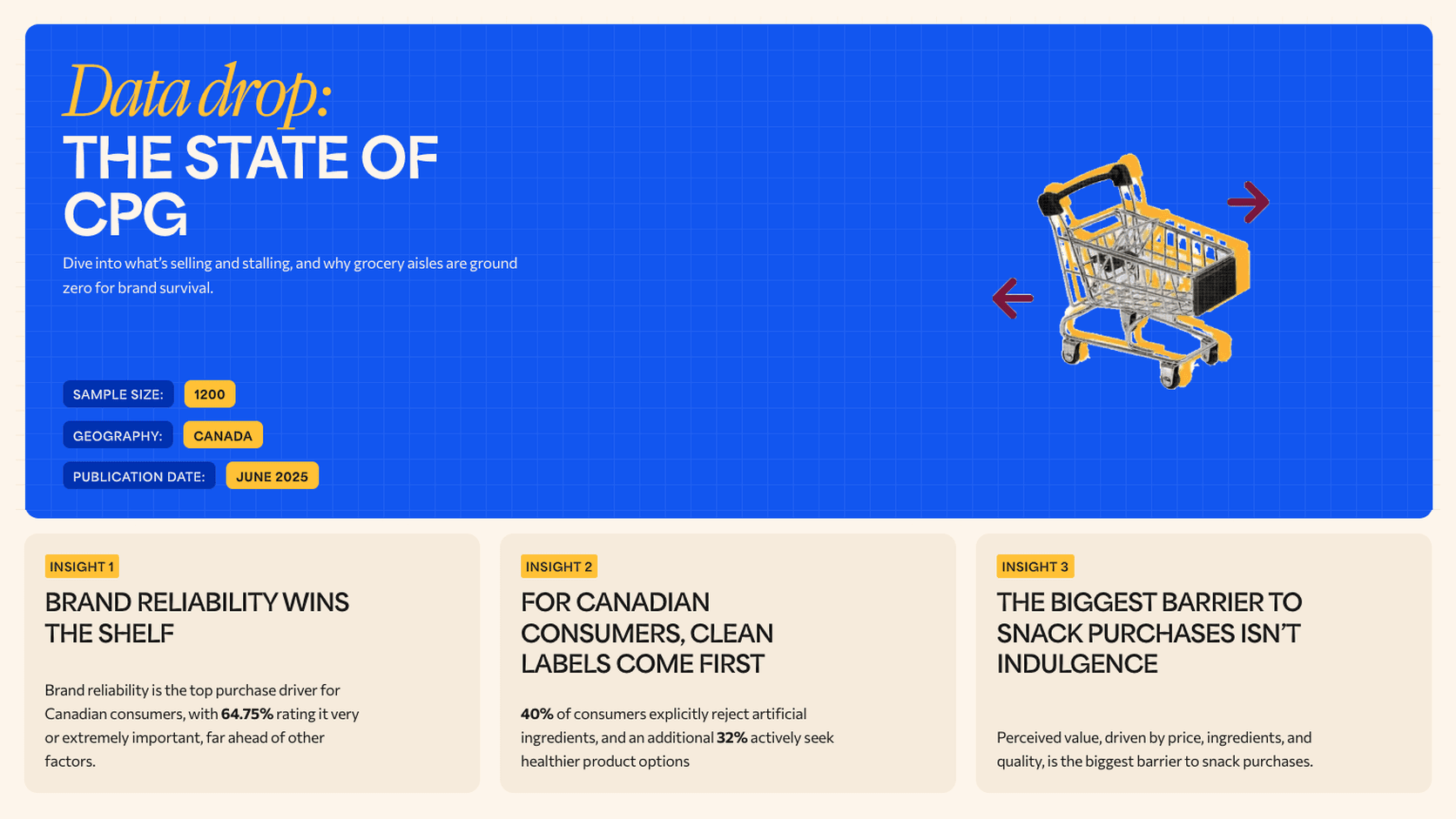
Short, punchy data releases designed for social media and PR. A single surprising statistic, paired with minimal context and strong design, can generate more engagement than a full report. Published examples like the state of CPG show how a focused data story travels.
Interactive Dashboards and Reports
According to TopRank/Ascend2, 78% of B2B marketers say interactive and experiential content increases repeat engagement, but only 33% regularly build it into their campaigns. That gap is an opportunity. Interactive reports let readers filter data by industry, role, or region, making the findings personally relevant rather than generically informative.
Executive Briefs
Two-to-four page summaries tailored for C-suite readers who won’t read a 40-page report. These distill the three or four most important findings into something a busy executive can absorb in five minutes.
Case Studies Backed by Proprietary Data
Standard case studies describe what happened. Research-backed case studies prove why it matters with original data. The combination of narrative and evidence is significantly more persuasive than either alone.
Webinar and Event Presentations
Forty-eight percent of marketers say interactive experiences, live events, and video make thought leadership more impactful. Presenting original research findings in a live format creates conversation and positions the researchers as authorities, not just the organization.
Metrics and ROI of Thought Leadership Research
How to Measure B2B Thought Leadership Research Performance
Thought leadership research should be evaluated using a combination of reach, engagement, audience quality, commercial influence, and business outcomes. The right measures depend on the purpose of the program and the time required for its impact to become visible.
Measurement stage | Metrics to track | What they tell you |
|---|---|---|
Reach | Relevant organic impressions, referral visits, media mentions | Whether the research reaches its intended audience |
Engagement | Engaged sessions, report completion, webinar attendance, content shares | Whether readers interact meaningfully with the findings |
Authority | Relevant backlinks, third-party citations, expert references | Whether other sources find the research useful enough to reference |
Audience development | Qualified registrations, newsletter subscriptions, relevant inquiries | Whether the content attracts people who may be valuable to the business |
Sales influence | Research used in sales conversations, opportunities engaging with research assets | Whether the research supports active buying processes |
Business outcomes | Qualified pipeline, influenced revenue, customer acquisition outcomes | Whether the program contributes to measurable commercial results |
Before fielding the study, define the intended audience, the business objective, the baseline, the metrics to track, and the measurement period. Use campaign tagging and CRM reporting where appropriate to connect content engagement with later commercial activity.
Distinguish between attributed outcomes and influenced outcomes. A lead who downloads a report may be associated with the campaign, but that does not prove the report caused the eventual purchase. Use consistent definitions and acknowledge the limitations of your attribution model.
The goal is not to prove that every research asset directly generated revenue. It is to understand whether the program reaches relevant buyers, strengthens credibility, supports commercial conversations, and contributes to the outcomes it was designed to influence.
Brand Trust and Credibility
Seventy-one percent of hidden buyers say thought leadership is more effective than conventional marketing or sales materials at demonstrating a vendor’s value. And 91% of hidden decision-makers say quality thought leadership helps them uncover challenges they hadn’t previously recognized. These are trust signals that compound over time.
Pipeline Influence
Top-performing B2B marketers are nearly four times more likely to report very high marketing ROI when using thought leadership across all funnel stages. A survey of 250 B2B buyers found they were twice as likely to exchange personal information for content featuring original research compared to content without it.
Growth Rate Differential
Organizations with mature thought leadership programs reported an average growth rate of 8.3%, compared to 6.5% for less mature counterparts. That 1.8 percentage point gap, compounded over several years, represents a significant competitive advantage.
The Measurement Challenge
Despite these numbers, 41% of B2B marketers cite difficulty proving ROI as a cause of underperforming content. The problem isn’t that thought leadership doesn’t work. It’s that most organizations lack the attribution infrastructure to connect a research report someone read in January to a deal that closed in September. Building measurement into the program from day one (tracking downloads, time spent, shares, sales team usage, and deal influence) is essential.
Explore case studies showing how brands use proprietary research to guide strategy and measure impact.
The AI and Original Research Dynamic
The Content Moat Concept
AI tools can generate blog posts, social media copy, and even passable analysis in seconds. What they cannot do is create proprietary data. Original research is the one asset AI cannot fabricate, making it what practitioners are calling a “content moat,” a strategic foundation that protects your differentiation.
As one practitioner newsletter put it bluntly: “AI is, by its very nature, a thought follower. You’ll never be a thought leader by using AI. What it can do is repackage the value.”
That’s the right framing. Use AI to amplify and distribute your original research faster. Use it to draft summaries, generate social posts from data points, and create variations for different audiences. But the research itself, the proprietary evidence, must come from real human respondents answering real questions.
Why This Matters More Every Quarter
Sixty-seven percent of B2B marketers say original research is more valuable than AI-generated content for building buyer trust. Thirty-two percent of professionals now discover thought leadership through generative AI tools, which means AI is increasingly the distribution channel. Content that AI tools cite needs to be original and authoritative. Generic content gets summarized and forgotten. Proprietary data gets cited and linked to.
A TrustSignals analysis captures the structural shift well: generic informational content is losing value not because there’s too much of it, but because AI can answer informational queries directly. Publishing more generic content faster doesn’t solve the problem. It accelerates production into a category where value has collapsed.
How to Make B2B Research Easier to Cite in Search and AI Answers
Original research can provide distinctive information that is not available in competing content. However, publishing proprietary data does not guarantee that search engines, journalists, or AI systems will discover, reference, or cite it.
To improve the clarity and accessibility of research findings:
Lead with the finding. State the most important result in a direct sentence before providing the interpretation.
Identify the source. Name the organization that conducted or commissioned the study.
Provide methodology context. Include the sample, target audience, field dates, and collection method near the relevant statistics.
Separate findings from interpretation. Make clear which statements come directly from the data and which are the authors' conclusions.
Publish accessible text. Ensure key findings are available as crawlable page content rather than only inside images, slides, or downloadable files.
Use descriptive headings. Structure sections around the questions the research answers.
Link to supporting evidence. Cite original reports, relevant methodology notes, and underlying sources where available.
Keep information consistent. Use the same figures, definitions, and caveats across the report, landing page, articles, and social content.
Update when needed. Clearly distinguish new findings from historical data and explain changes between research editions.
The objective is to make the research easy for people to understand and verify. Better structure and source transparency support discoverability, but no particular format guarantees inclusion in an AI-generated answer.
Getting Started: From Internal Insight to Published Research
The process is more accessible than most teams assume. You don’t need a six-figure agency retainer or a twelve-month timeline.
Step 1: Identify a business tension. What question does your industry argue about but nobody has data on? What assumption do buyers hold that might be wrong? The best thought leadership research starts with a genuinely interesting question.
Step 2: Design the study. Choose your methodology (survey, interviews, or both) and define your target audience precisely. A survey of 500 marketing directors will produce very different insights than a survey of 500 CFOs, even on the same topic.
Step 3: Field to a verified audience. Respondent quality determines data quality. Panels built on verified participants produce credible findings. Understanding your customer before designing the study ensures you’re asking the right people the right questions.
Step 4: Analyze and build the narrative. Numbers don’t speak for themselves. The analysis phase is where you find the story: the counterintuitive finding, the gap between perception and reality, the trend nobody saw coming.
Step 5: Publish and atomize. Release the flagship report, then break it into data drops, social content, executive briefs, sales enablement materials, and PR pitches. A single study should fuel three to six months of differentiated content.
How to Turn One Research Study Into a Thought Leadership Content Program
A well-designed research study can support multiple content formats without requiring a new survey for every asset. The key is to give each asset a clear audience, purpose, and evidence base.
Research asset | Purpose | Example output |
|---|---|---|
Flagship report | Present the full methodology, findings, and implications | Annual B2B industry report |
Data-led article | Explain one important finding in depth | An article on a surprising buyer behavior trend |
Data visualization | Make a finding easy to understand and share | A chart showing differences between buyer groups |
Executive brief | Help senior stakeholders absorb the implications quickly | A two-page summary of key findings |
Webinar or presentation | Explain findings and encourage discussion | A research briefing for industry professionals |
PR pitch | Give journalists a timely, evidence-backed story | A pitch built around a genuinely newsworthy finding |
Sales enablement asset | Help sales teams explain a buyer problem or industry trend | A research-backed slide for discovery conversations |
Follow-up study | Test whether an important pattern persists | A comparable survey conducted at a later date |
Identify the strongest findings and document the evidence behind each one.
Match each finding to the audience most likely to care about it.
Create the flagship report and supporting assets from the same verified dataset.
Adapt the framing and format to each channel without changing the underlying meaning of the findings.
Track distribution, engagement, qualified demand, and sales use.
Use audience feedback and performance data to identify the next research question.
Repurposing research should never mean removing caveats or presenting a finding as more conclusive than the original study supports.
For teams ready to run their first B2B thought leadership research study, request a demo to see how the process works end to end.
Frequently Asked Questions
What is the difference between thought leadership research and market research?
Market research is typically conducted for internal decision-making: pricing strategy, product development, competitive analysis. Thought leadership research is designed from the start for public consumption. The findings become content that builds credibility and influences buyers. The methodologies overlap, but the intent and audience are fundamentally different.
How many respondents do you need for a credible B2B thought leadership survey?
For most B2B topics, 400 to 800 respondents provide enough statistical weight to support meaningful analysis and segmentation. Smaller samples (150 to 300) can work for highly specialized audiences like CISOs at Fortune 500 companies, but you’ll have limited ability to cut the data by subgroups. The key is that the sample is representative and the respondents are verified.
How long does it take to produce a thought leadership research report?
Timelines vary widely. Traditional agency-led programs often take three to six months. Modern research platforms can field surveys in 24 to 72 hours and deliver initial analysis within days. The longest phase is usually narrative development and design, which typically takes two to four weeks after data collection. Total timeline from concept to published report can be as short as four to six weeks.
Can small businesses do B2B thought leadership research?
Yes. The barrier to entry has dropped significantly. You don’t need an enterprise budget or a dedicated research team. Self-serve and guided research platforms make it possible for SMBs to design, field, and publish original studies at a fraction of what agencies charge. A focused study of 400 respondents on a specific industry question can produce months of differentiated content.
How does original research improve SEO?
Original data earns backlinks because journalists, bloggers, and analysts cite statistics they can’t find elsewhere. A single proprietary finding that gets widely cited can generate dozens of high-authority backlinks. Beyond links, original research content tends to have higher engagement metrics (time on page, shares, return visits) that correlate with stronger search rankings.
What makes B2B thought leadership research fail?
The most common failure modes are asking questions nobody cares about, surveying the wrong audience, burying the interesting findings under corporate messaging, and publishing once without atomizing the content. According to Momentum ITSMA, 41% of buyers say thought leadership is often unoriginal and unstimulating, and 38% say it lacks direct relevance to their needs. Research quality and editorial courage both matter.
Is thought leadership research worth the investment compared to other content types?
The data says yes. Organizations with mature thought leadership programs grow 1.8 percentage points faster than peers. B2B buyers are twice as likely to exchange personal information for content featuring original research. And 60% of decision-makers will pay a premium to work with companies that produce strong thought leadership. Few other content investments show that kind of measurable commercial impact.