Article
Original Research Marketing: What It Is & Why (2026)

On this page
By Michelle Aboud, Head of Marketing at Cashew
Original research marketing turns proprietary data and new analysis into content that an audience can use.
Instead of repeating statistics published by other companies, brands conduct surveys, interviews, experiments, or analyses of their own data to uncover findings that add something new to the market. Those findings can then become reports, charts, articles, campaigns, content strategies, PR pitches, social content, microsites, webinars, sales materials, and other marketing assets.
The opportunity is especially relevant as AI makes it easier to produce competent content at scale. Google’s guidance for AI search emphasizes the importance of unique, valuable, non-commodity content rather than simply restating information already available elsewhere. Original research can provide exactly that kind of first-hand evidence - provided the study is well designed and the findings are presented transparently.
This guide explains what original research marketing is, how it differs from market and secondary research, which research formats work best, how to design a credible study, how to turn one study into multiple marketing assets, and how to measure its SEO and business impact.
If you’re evaluating whether to invest in research-backed content, explore research-led content programs to see what the process looks like in practice.
What Is Original Research Marketing?
Original research marketing is the practice of collecting or analyzing unique data and publishing the resulting findings as marketing content. It can involve surveys, interviews, experiments, proprietary behavioral data, customer research, or new analysis of existing datasets. The goal is to turn original evidence into content that informs an audience while building authority, generating media coverage and backlinks, supporting sales, and creating reusable marketing assets.
The simplest way to think about it is:
Original data → New insight → Published finding → Distribution → Business value
Unlike secondary research, which summarizes or cites information published by others, original research gives your brand a chance to become the source of a finding. However, original research is only valuable when the methodology, sample, analysis, and limitations are credible enough to support the claims being made.
Key takeaway
Original research marketing is not simply publishing a survey or report. It is the process of creating credible, useful evidence and turning that evidence into content that other people can reference, share, cite, and act on.
Original Research Marketing at a Glance
Question | Answer |
|---|---|
What is it? | Creating new evidence through primary research, proprietary data analysis, or original analysis and publishing the findings as marketing content. |
Why do it? | To build authority, create useful content, generate PR opportunities, earn citations and backlinks, support sales, and create reusable marketing assets. |
What are common formats? | Surveys, interviews, experiments, benchmark studies, proprietary data analysis, data synthesis, and short-form polls. |
What makes it credible? | A clearly defined audience, appropriate sampling, unbiased questions, transparent methodology, sound analysis, and honest reporting of limitations. |
How does it help SEO? | Original findings can become citation-worthy sources, attract relevant links, target statistics-related searches, and create multiple supporting content assets. |
Does it guarantee AI citations? | No. Google says there are no special technical requirements for appearing in AI Overviews or AI Mode beyond being indexed and eligible for Search. Unique, useful, reliable content can improve your chances of being surfaced. |
How large should the sample be? | There is no universal minimum. Sample size should be determined by the population, research objective, desired precision, subgroup analysis, sampling method, and budget. |
What Original Research Marketing Actually Means
Original research marketing is the process of conducting a primary study, then publishing the findings and insights as content for external audiences. The key requirement: the data didn’t exist before you collected it.
This is different from writing a blog post that cites someone else’s statistics. That’s secondary research. Useful, sure, but commoditized. Anyone can cite a report that is open to the public. When you run your own 500-person survey on consumer attitudes toward sustainable packaging, nobody else has that data. You become the source.
A more precise definition: original research marketing is the process of generating unique insights from first-party data or primary data collection, then publishing those findings transparently so they function as both a credibility asset and a content engine.
What It Is Not
This distinction trips people up. A few clarifications, drawn from practitioner discussions:
It is not a summary of existing content. Repackaging old data into a new PDF and slapping “research report” on the cover doesn’t qualify. Journalists and readers see through this quickly, and it damages credibility rather than building it.
It is not a collection of case studies. Case studies are valuable sales tools. Compiling them into a document and calling it a “research report” misuses both formats.
It is not customer research (usually). Surveying only your existing customers creates inherent bias, limited scope, and questionable demographic diversity. Original research for marketing purposes typically requires a broader, more representative sample. Curious to see how well you know your customers?
How Does Original Research Marketing Work?
Original research marketing usually follows a six-stage process:
1. Identify a question worth answering
Start with a question your audience, industry, journalists, or potential customers genuinely care about. The strongest topics are specific enough to produce a meaningful finding but broad enough to interest people beyond your existing customer base.
2. Choose the right research method
Decide whether a survey, interview study, experiment, proprietary data analysis, benchmark study, or another method is best suited to answering the question.
3. Collect or analyze the data
Recruit the appropriate participants or analyze a dataset you have permission to use. Document how the data was collected, who was included, when the research took place, and any exclusions or quality controls.
4. Analyze the findings
Look for meaningful patterns rather than simply reporting every result. Separate statistically meaningful findings from directional observations, and avoid presenting correlation as proof of causation.
5. Publish the evidence transparently
Make the important findings easy to find and cite. Include the methodology, sample information, fieldwork dates, definitions, charts, and limitations. If a finding is based on a small subgroup or non-representative sample, say so.
6. Distribute and repurpose the research
Turn the strongest findings into articles, microsites, charts, social posts, PR pitches, webinars, sales materials, newsletters, and other assets. The original report should be the beginning of the content campaign rather than the end.

The process can be summarized as:
Question → Method → Data → Analysis → Finding → Publication → Distribution → Repurposing → Measurement
Why Is Original Research Marketing Important?
Original research can create a marketing asset that competitors cannot simply reproduce by rewriting the same sources. Its value comes from the combination of new evidence, credibility, distribution potential, and reusability.
A strong study can contribute to several marketing objectives at once:
Authority: Your brand becomes the source of a new finding rather than another publisher repeating an existing statistic.
SEO: Research can attract relevant links and citations when writers need data to support their own content. Original research has long been recognized as a strong linkable content format.
Content efficiency: One study can produce articles, graphics, webinars, social posts, email campaigns, and sales materials.
PR: Newsworthy findings give journalists and publications a concrete data point around which to build a story.
Sales enablement: Research can give sales teams evidence to support conversations with prospects.
Audience insight: The research itself can reveal attitudes, behaviors, or trends that inform future marketing and product decisions.
AI-search visibility: Unique, useful research can strengthen the originality and information value of a page. Google specifically recommends creating unique, valuable, non-commodity content for its generative AI search experiences.
The important distinction is that original research does not automatically produce rankings, backlinks, leads, or AI citations. Those outcomes depend on research quality, topic selection, publication quality, distribution, and how useful the findings are to the audience.
Authority and Trust
For a concrete example of how research-backed content breaks internal echo chambers, see how Helcim used external insight to reshape their competitive positioning.
Backlinks and SEO Performance
Original data is one of the most effective link-building strategies available. Eucalypt Media reports that launching original research reports with associated PR campaigns has yielded 50+ new backlinks from a single report within months. Stratabeat found that websites using original research see a 25% lift in top-ranking keywords.
A 200-person survey is enough to become a citable source. Journalists need data for their stories. If your brand is the one providing it, you earn links without the transactional link-building tactics that Google increasingly penalizes.
Lead Generation and Conversion
This isn’t just a brand play. Datalily’s 2025 data shows that 64% of marketers reported higher conversion rates from content-sourced leads after adopting proprietary research, and 61% reported improved organic traffic. Research from 6sense, cited by TopRank, found that 55% of B2B buyers regularly consume research reports and rate them as the most valuable content type when evaluating purchasing decisions.
The Content Multiplier Effect
One study can fuel an entire content calendar. Andy Crestodina of Orbit Media has called original research “PHENOMENAL seed content,” noting it fuels blog posts, webinars, podcasts, videos, and white papers. A quality research study should provide enough material for six to nine months of content, delivering strong ROI in visibility, leads, and sales opportunities.
Derivative formats from a single study include the full report (gated or ungated), blog posts on individual findings, infographics, social media stat cards, PR pitches, webinar presentations, podcast talking points, sales one-pagers, conference talk submissions, and email drip campaigns.
For examples of this multiplier in action, see The Dupe Report or The State of CPG, both built from proprietary survey data and repurposed across channels.
Original Research Marketing and AI Search
Original research has an important role to play in AI-assisted search because it can give search systems and readers information that is difficult to obtain from generic summaries.
Google's guidance for AI Overviews and AI Mode does not identify a special “LLM optimization” technique or guarantee that primary research will be cited. Instead, Google recommends applying the same foundational SEO principles: create useful, reliable, original content, make the page accessible to Search, and provide information that adds value beyond what is already available elsewhere.
Original research can support those principles in several ways:
Unique evidence: Your findings may not exist anywhere else.
Clear attribution: Readers can identify who conducted the research and when.
Specific findings: Individual statistics can directly answer narrow questions.
Methodological transparency: Explaining how the research was conducted makes the findings easier to evaluate.
First-hand insight: The content can demonstrate experience and analysis rather than simply summarizing other sources.
Citation opportunities: Journalists, researchers, marketers, and publishers may reference useful findings in their own work.
Use descriptive headings, concise explanations, accessible tables, charts with supporting text, and a clearly documented methodology. The goal is not to “hack” AI citations. The goal is to create a source that is genuinely worth citing.
Types of Original Research Used in Marketing
Not all original research looks the same. Here are the six most common formats.
Survey-Based Research

The dominant format. According to Mantis Research, 65% of marketers conducting original research use surveys. These produce the classic “State of X” reports. Think CMI’s annual B2B Content Marketing report or the Mantis/Buzzsumo State of Original Research survey. A survey of 200+ respondents from a representative sample gives you statistically credible data that journalists and other content creators will cite.
If you’re considering running your own survey, Cashew’s end-to-end research platform handles study design, respondent recruitment, fielding, and reporting in one place.
Annual Benchmark Studies
These track key metrics or industry trends over time. The power of benchmarks is compounding: each year’s data becomes more valuable because it shows change. Orbit Media’s annual blogging survey is a textbook example. Marketers reference it year after year, and each edition earns a fresh wave of backlinks.
One-Off Topical Research
Research focused on a single emerging trend, industry disruption, or niche question. These are timely and often produce the most viral results because they address something people are actively curious about right now. The tradeoff is that they have a shorter shelf life than benchmark studies.
Proprietary Data Analysis
You don’t always need a survey. If your platform generates usage data, transaction data, or behavioral data, analyzing it for patterns can produce genuinely novel insights. Databox is the poster child here. CMSWire reported that Databox produced more than 1,300 reports from their own product data and now generates nearly 300,000 sessions per month, mostly from organic search, converting into 6,000+ free product signups monthly.
Data Aggregation and Synthesis
Combining publicly available datasets in a new way to reveal a trend nobody had mapped. For example, cross-referencing Census data with industry spending data to surface an underreported demographic shift. The data is public, but your analysis is original.
Short-Form Polls
Quick social media or community polls that produce shareable micro-data points. These won’t anchor a full report, but they generate social engagement and can serve as “proof of concept” before investing in a larger study.
How to Make Original Research Credible
Publishing original data does not automatically make a study credible. The quality of the research depends on how the question was defined, how participants or data were selected, how the study was conducted, and how the results were analyzed.
Define the research population
Start by identifying exactly who the research is supposed to represent. “Consumers” is usually too broad. A more useful definition might be “U.S. adults who purchased a functional beverage in the past six months.”
Use an appropriate sample
Your sample should match the population you want to understand. If you need to make claims about a broader market, relying only on your email subscribers, employees, or existing customers can introduce selection bias.
Write neutral questions
Avoid leading, loaded, or double-barreled questions.
Instead of:
“How much do you love our faster and more affordable product?”
Use:
“How satisfied are you with the product's speed?”
Neutral questions reduce the risk of influencing respondents toward a particular answer.

Document the methodology
At minimum, disclose:
Who participated
Sample size
Geographic market
Fieldwork dates
Recruitment or sampling method
Screening criteria
Relevant demographic or professional characteristics
Weighting, if used
Major exclusions or quality controls
How results were analyzed
Report limitations
A credible study explains what it cannot prove.
For example, a survey may reveal that two variables are associated, but that does not necessarily mean one caused the other. Likewise, a non-probability sample may provide useful directional insights without supporting population-level estimates with the same precision as a probability sample.
Make the findings reproducible enough to evaluate
You do not necessarily need to publish respondent-level data. However, readers should have enough methodological information to understand where the findings came from and judge whether the conclusions are supported by the evidence.
Rule of thumb: The stronger the claim, the stronger and more transparent the evidence should be.
Original Research vs. Related Terms
This is where confusion runs rampant. Here’s a clear breakdown.
Original Research Marketing | Market Research | Marketing Research | Secondary Research | |
|---|---|---|---|---|
Definition | Primary studies conducted and published as external content | Studies conducted for internal strategic decisions | Broad discipline covering all research that informs marketing | Citing, synthesizing, or repackaging existing published data |
Purpose | Authority, backlinks, PR, leads, LLM citations | Understand market size, competitors, customer needs | Inform product development, positioning, brand strategy | Support arguments with existing evidence |
Primary Audience | External (prospects, journalists, industry peers) | Internal (executives, product teams, strategists) | Internal and sometimes external | External (blog readers, report consumers) |
Typical Output | Published reports, blog posts, infographics, data drops | Internal decks, strategy documents, dashboards | Varies widely by application | Blog posts, roundup articles, literature reviews |
The overlap: the same methods (surveys, interviews) can serve both original research marketing and market research. The differentiator is whether findings are published externally as a content asset or kept internal for strategy.
Marketing research is the broadest category. It covers everything from brand awareness studies to pricing research to distribution analysis. Market research, focused specifically on understanding the market (place, size, competition), is a subset of marketing research.
How to Repurpose Original Research into Marketing Assets
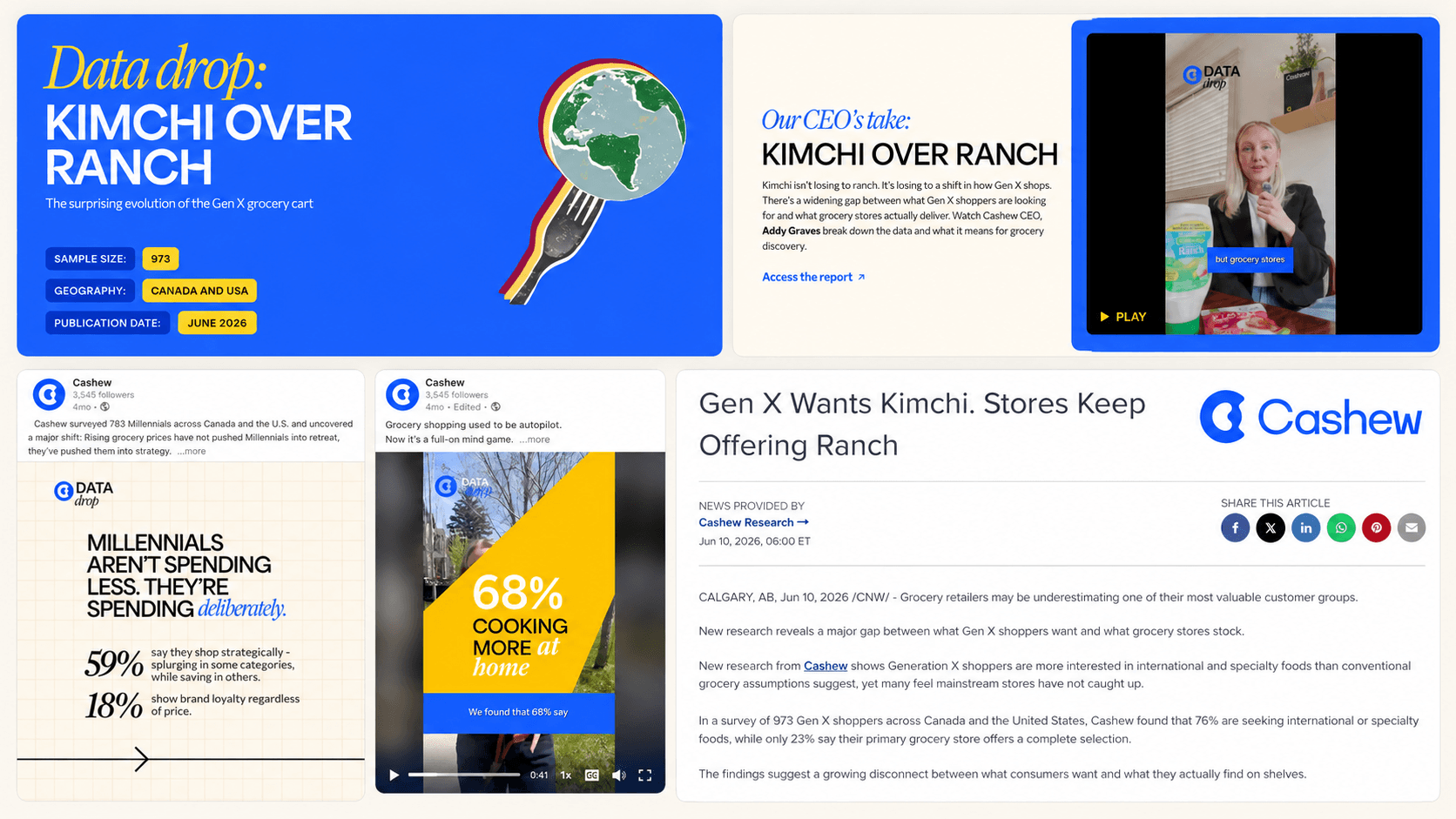
Most marketers stop at the PDF. That’s the single biggest waste of research investment. The real value is in the derivative content engine.
Michele Linn, founder of Mantis Research, has noted that a common mistake is not repurposing beyond the initial report. Here’s the full list of what one study can produce:
The full report (gated for lead capture or ungated for maximum reach)
Individual finding blog posts (each key stat gets its own article)
Infographics (visual summaries of the top findings)
Social media stat cards (single-stat graphics optimized for sharing)
“Data Drops” (bite-sized findings published as standalone social or blog content)
PR pitches and press releases (the most newsworthy findings, packaged for journalists)
Webinar presentations (walk through findings with live Q&A)
Podcast talking points (guest appearances built around your data)
Sales enablement one-pagers (proof points reps can hand to prospects)
Conference talk submissions (proposals backed by proprietary data get accepted more often)
Email drip campaigns (sequence of key findings delivered over weeks)
See how joni built a research-to-content pipeline using proprietary data to differentiate as they scaled from DTC to multi-channel.
Common Mistakes in Original Research Marketing
Biased Survey Design
Leading questions, double-barreled questions, and response options that steer answers all undermine credibility. If your methodology doesn’t hold up to scrutiny, the findings won’t earn trust, and journalists will pass.
Surveying Only Your Customers
Your customer base is self-selected. They already bought from you. Their views don’t represent the broader market. For original research that’s meant to build industry authority, you need a broader, more representative sample from a verified research panel.
Repackaging Old Data as “Original”
Pulling numbers from last year’s report, adding a new introduction, and calling it original research fools nobody. Every data point should be freshly collected or, at minimum, clearly dated and contextualized.
Failing to Promote
Research doesn’t promote itself. Practitioners on Reddit and LinkedIn consistently report that the biggest regret after publishing a study is underinvesting in distribution. The research is the starting line, not the finish line. Budget time and resources for outreach, social amplification, and ongoing repurposing.
Publishing Once and Moving On
The Orbit Media 2025 survey found that almost half of content programs now publish original research, but only 25% of those who do report strong results. One likely reason: they publish the report and never touch the data again. The multiplier effect only works if you actually execute it.
How to Get Started
The budget barrier is real but overstated. Mantis Research found that of marketers who haven’t published research, 49% cited lack of budget or lack of knowledge on how to execute. Here’s a practical path forward.
Pick a topic your audience cares about, not one that validates your product. The best research answers a question the industry is debating. If the findings are genuinely useful regardless of whether someone buys from you, you’ve chosen the right topic.
Define your audience and sample size. A 200-person survey from a representative sample is enough to produce credible, citable findings. Larger samples add precision, but 200 is a strong starting point.
Use a vetted panel or partner for unbiased reach. Sending a survey only to your email list introduces selection bias. A research panel gives you access to respondents who match your target demographic without the bias of an existing relationship.
Build, field, and publish fast. Speed matters. Trends shift, and the first brand to publish data on an emerging topic captures the most attention. Platforms that handle study design, respondent recruitment, and reporting in one workflow compress timelines from months to days.
Repurpose relentlessly. Plan your derivative content before you even field the survey. Know which findings will become blog posts, which will become social stat cards, and which will anchor your PR pitch.
To see how the full process works end-to-end, from study design to published findings, request a demo and walk through it with a researcher.
FAQ
How much does original research marketing cost?
Costs vary widely. A 200-person online survey can cost a few thousand dollars when using a research platform with built-in panel access. Full-service agency studies with large sample sizes can run into the tens of thousands. The ROI math tends to be favorable: a single report can yield 50+ backlinks, months of derivative content, and measurable lead generation. Check how pricing works for a sense of the investment.
How many survey responses do I need for credible original research?
A minimum of 200 responses from a representative sample is widely considered the threshold for publishable findings. Larger samples (500+) increase statistical confidence and allow for more granular segmentation, but 200 is enough to produce data that journalists and other brands will cite.
What’s the difference between original research marketing and content marketing?
Content marketing is the broad discipline of creating and distributing valuable content to attract and retain audiences. Original research marketing is a specific tactic within content marketing where the content is built on proprietary data rather than opinions, how-to advice, or curated information. It’s a subset, not a replacement.
Can small businesses afford to do original research?
Yes. The perception that original research requires enterprise budgets is one of the main reasons adoption remains low. A focused survey on a narrow topic, fielded through an affordable research platform, can produce findings that punch far above their weight in terms of backlinks, media coverage, and authority.
How does original research help with AI search and LLMs?
AI models and answer engines prefer citing primary sources with clear methodology and discrete, quotable findings. When your brand is the original source of a statistic, LLMs are more likely to reference you in generated answers. Secondary content that merely aggregates existing data gets deprioritized. Original research is one of the few content investments that works in both traditional SEO and the emerging answer-engine layer.
How long does it take to produce an original research report?
Timelines range from two weeks to several months depending on complexity, sample size, and whether you’re using a self-serve platform or a full-service agency. Survey-based studies with 200-500 respondents can be fielded in 24-72 hours on modern platforms, with analysis and reporting following shortly after.
What types of companies benefit most from original research marketing?
B2B companies, SaaS brands, professional services firms, and consumer brands in competitive categories tend to see the strongest returns. Any brand competing in a space where trust and expertise drive purchasing decisions will benefit. The 55% of B2B buyers who regularly consume research reports represent a large, engaged audience waiting for credible data.
Should I gate my research report behind a form?
It depends on your goals. Gating maximizes lead capture but limits reach, backlinks, and citations. Ungating maximizes distribution and SEO value. A common compromise: publish key findings openly (blog posts, infographics, social stat cards) while gating the full report. This gives journalists and content creators enough to cite and link to while still generating leads from readers who want the complete dataset.