Article
Proprietary Research Report: Definition & Types (2026)

On this page
By Waleed Nesyif, CGO at Cashew
A proprietary research report is an original study whose data is owned exclusively by the organization that produced or commissioned it. Unlike syndicated research sold to multiple buyers, proprietary research gives one company exclusive findings that competitors cannot access. These reports have become the most valuable content asset in marketing because AI tools and search engines cannot replicate original data, making them a top priority for brands investing in thought leadership and content differentiation.
Explore the platform behind research-led content programs that turn proprietary data into marketing assets.
What Is a Proprietary Research Report?
A proprietary research report is a study containing original data or analysis that is produced or commissioned for a specific organization and is not routinely available to its competitors. It can include surveys, interviews, customer research, behavioral data, benchmarking studies, or proprietary indexes. Unlike syndicated research, which is sold to multiple organizations, proprietary research is designed around a company’s specific questions, audience, or business objectives.
In marketing, proprietary research can serve two purposes: helping a company make better decisions and creating original evidence that can be published as content, used in PR, shared with customers, or turned into thought leadership.
Definition of a Proprietary Research Report
A proprietary research report is a study containing original data, analysis, or insights that is produced or commissioned for a specific organization and is not routinely available to its competitors.
The defining characteristic is exclusivity. The research is designed around a particular company's business question, audience, product, market, or strategic objective. Depending on the research agreement, the organization may own the underlying data, receive exclusive rights to the findings, or have contractual rights to use and publish the research.
Proprietary research can take many forms, including consumer surveys, customer interviews, behavioral analysis, benchmarking studies, longitudinal trackers, segmentation research, and proprietary indexes.
For example, a company might survey 2,000 consumers about how they choose products in a particular category. If the study was commissioned specifically for that company and the resulting findings are not sold as the same standardized dataset to competitors, the resulting report can function as proprietary research.
The important distinction is not simply whether the information is “new.” It is whether the organization has created or commissioned original evidence that gives it exclusive or differentiated access to the resulting findings.
Proprietary Does Not Always Mean Private
A proprietary research report can be completely confidential, but it does not have to be.
Companies often publish proprietary findings as reports, articles, data visualizations, press releases, webinars, or thought leadership. The research remains proprietary because the underlying study and findings originated from the organization rather than being copied from publicly available sources.
In other words, proprietary describes the ownership or exclusivity of the research, not whether the findings are published.
Proprietary vs. Syndicated vs. Secondary Research

The most common confusion around proprietary research reports involves how they differ from syndicated and secondary research. Here is the core distinction: it comes down to who owns the data, what questions it answers, and who else can access it.
Factor | Proprietary Research | Syndicated Research | Secondary Research |
|---|---|---|---|
Main purpose | Answer a specific business question | Provide standardized market benchmarks | Provide context from existing information |
Data access | Exclusive or differentiated access | Available to multiple buyers | Generally publicly or commercially available |
Customization | High | Limited | None at the original collection stage |
Research questions | Designed around your objectives | Predefined by the research provider | Determined by existing sources |
Competitive differentiation | High potential | Moderate to low | Usually low |
Cost | Varies by scope and methodology | Usually priced by the provider | Often free or relatively inexpensive |
Speed | Depends on study design | Usually available once published | Usually immediate |
Best use | Decisions, positioning, thought leadership | Benchmarking and market context | Background research and trend analysis |
Use secondary research for context, syndicated research for benchmarks, and proprietary research when you need evidence built around a question your competitors cannot answer from the same dataset.
As one marketing strategist put it: “Syndicated data is continuous standardized measurement sold to every competitor in a category, which makes it an excellent scoreboard and a poor source of advantage. Custom research is the only evidence whose question is proprietary.”
The practical implication is straightforward. Use syndicated research to benchmark. Use secondary research to build context. Use proprietary research to find the insights that actually differentiate your brand. Helcim, a fintech company, discovered this firsthand when they realized internal data alone was creating an echo chamber. External proprietary research gave them a clearer competitive picture they could not get any other way.
What Qualifies as Proprietary Research?

Not every original-looking report is proprietary research. A useful test is whether the organization created or commissioned a distinct body of evidence and has exclusive or differentiated rights to the resulting findings.
Research is more likely to qualify as proprietary when it has these characteristics:
Original data: The study collects new information through surveys, interviews, experiments, observations, or other research methods.
A defined research objective: The study answers a specific business, customer, market, or strategic question.
A defined audience or sample: The report explains who was studied and why that population matters.
Distinct methodology: The research design is documented rather than presented as unsupported opinion.
Exclusive or differentiated findings: Competitors cannot simply purchase the identical dataset as a standard syndicated product.
Documented analysis: The report explains how raw responses or observations were analyzed.
Clear rights: The organization understands who owns the data, who can publish the findings, and how the research can be reused.
What Does Not Usually Count?
A report is not automatically proprietary because a company published it under its own brand.
For example, rewriting public statistics into a branded PDF does not create proprietary research. Neither does compiling existing articles without collecting new data or performing meaningful original analysis.
The strongest proprietary reports add something that did not previously exist: new data, new analysis, or a new measurement framework.
Is Proprietary Research the Same as Primary Research?
Not necessarily.
Primary research describes how the information was collected: the researcher gathers new data directly through methods such as surveys, interviews, experiments, observations, or focus groups.
Proprietary research describes the access, ownership, or exclusivity of the resulting research.
The two concepts often overlap, but they are not identical.
Research type | What it describes | Example |
|---|---|---|
Primary research | Data collected directly by the researcher | A survey of 1,500 consumers |
Secondary research | Analysis of existing information | An analysis of government statistics |
Proprietary research | Research with exclusive or differentiated access | A customer study commissioned exclusively for one brand |
Syndicated research | Standardized research sold to multiple buyers | An industry benchmark purchased by several companies |
A proprietary research report can contain primary research, secondary analysis, or a combination of both. For example, a company could commission an exclusive consumer survey and combine those findings with public economic data.
The simplest way to remember the distinction is:
Primary = where the data came from.
Proprietary = who has exclusive access to the research or findings.
Syndicated = the same research is sold to multiple buyers.
Secondary = the data already existed before your analysis.
Common Types of Proprietary Research Reports
Types of Proprietary Research Reports
The best format depends on the business question, target audience, and how the findings will be used. Common types include:
1. Consumer Surveys and Audience Studies
Surveys collect structured responses from a defined target audience. They can measure attitudes, behaviors, preferences, awareness, purchase intent, satisfaction, or category perceptions.
Best for: consumer insights, messaging, positioning, trend research, and content marketing.
2. Customer Research
Customer research focuses specifically on existing users or buyers. It can examine satisfaction, purchasing behavior, customer needs, switching drivers, or unmet expectations.
Best for: product strategy, customer experience, retention, and messaging.
3. Benchmark and Industry Reports
Benchmark reports compare performance, behaviors, or attitudes across companies, markets, or time periods.
Best for: B2B thought leadership, benchmarking, sales enablement, and industry education.
4. State-of-Industry Reports
These studies survey a defined professional or consumer population to identify emerging trends, behaviors, challenges, and priorities.
Best for: PR, thought leadership, demand generation, and executive audiences.
5. Proprietary Indices and Trackers
A proprietary index combines multiple measurements into a recurring score or benchmark. Repeating the same methodology over time allows a company to track changes and build a recognizable research asset.
Best for: recurring content programs, trend monitoring, media outreach, and category leadership.
6. Segmentation Studies
Segmentation research identifies groups of people with meaningfully different needs, behaviors, motivations, or preferences.
Best for: targeting, positioning, product development, and personalization.
7. Behavioral and Usage Research
Behavioral research analyzes what people actually do rather than relying only on what they say they do. Depending on the organization and permissions involved, this can include product usage, purchase behavior, website behavior, or other first-party datasets.
Best for: product decisions, customer experience, optimization, and behavioral insights.
Why Proprietary Research Reports Matter Now
Original research has always been valuable, but three forces have made it essential in 2025 and 2026.
AI Content Saturation Raised the Bar

Content fatigue has reached a tipping point. Audiences scroll past generic “5 tips” articles because they have seen the same recycled advice hundreds of times. AI-generated content has accelerated the problem. The only content that breaks through consistently is content built on data nobody else has.
The Citation Flywheel
Search engines and AI systems value citations. When reputable sites link to your proprietary research report, it signals trust. That boosts your rankings, which drives more traffic, which leads to more citations. It is a compounding effect. When your report becomes the default data point journalists and analysts reach for, you gain visibility across thousands of AI-generated responses, articles, and presentations.
This is what Cashew Research calls research-led content: turning proprietary findings into press-ready assets that fuel earned media and organic growth.
Measurable Growth Correlation
According to a study by the Hinge Research Institute, the fastest-growing B2B service businesses were 3x more likely to use original research in their content marketing strategy. That correlation is hard to ignore.
Practitioners report dramatic results from individual reports too. Column Five Media documented one proprietary research report that generated 600 downloads in its first week and continued driving results for a full year. Lauren Lang, head of content at Uplevel, had a research report generate 1,500 downloads and a 500% increase in web traffic.
Proprietary Research vs. Recycled or Aggregated Data
A common alternative to commissioning new research is to build content from existing studies, reports, surveys, and public datasets.
That approach can be useful, but it serves a different purpose.
Approach | What you get | Main advantage | Main limitation |
|---|---|---|---|
Proprietary research | Original evidence | Differentiation and exclusive findings | Requires research investment |
Secondary research | Existing evidence | Fast context and background | Others can access the same sources |
Aggregated research | Multiple existing sources combined | Broader market picture | Findings are not necessarily exclusive |
Proprietary analysis | New analysis of owned or licensed data | Can reveal unique patterns | Depends on data quality and access |
The best content strategies often combine these approaches.
Use existing research to understand what is already known. Then use proprietary research to answer the questions that remain unanswered.
This creates a simple research hierarchy:
Existing evidence → identify the gap → conduct original research → analyze the findings → publish useful insights.
The objective is not to make every piece of content proprietary. It is to know when original evidence creates enough additional value to justify the investment.
How a Proprietary Research Report Gets Made
The process typically follows five stages.
1. Study Design. Define the business question, target audience, and methodology. Common approaches include structured surveys, MaxDiff analysis for prioritization, Van Westendorp for pricing research, and segmentation studies. Good study design starts with understanding your customer base before writing a single survey question.
2. Audience Recruitment. Source respondents from a verified panel, your own CRM lists, or a combination. Quality matters more than quantity here. Bot-filled or incentive-gamed panels produce data nobody should trust.
3. Fielding. Deploy the survey and collect responses. Fast field times (as short as 24 to 72 hours on modern platforms) mean you are not waiting weeks to see results.
4. Analysis. Clean the data, run statistical analyses, and extract the findings that tell a story. This is where a good research team separates signal from noise.
5. Reporting and Distribution. Package findings into an interactive or designed report, then repurpose into derivative content: blog posts, social graphics, press releases, webinar presentations, and data-driven pitches to journalists.
For teams that want to see how the process works end-to-end, request a demo to explore flexible options from self-serve to fully supported research.
Real-World Examples of Proprietary Research Reports
Turo’s 2026 USA Road Report
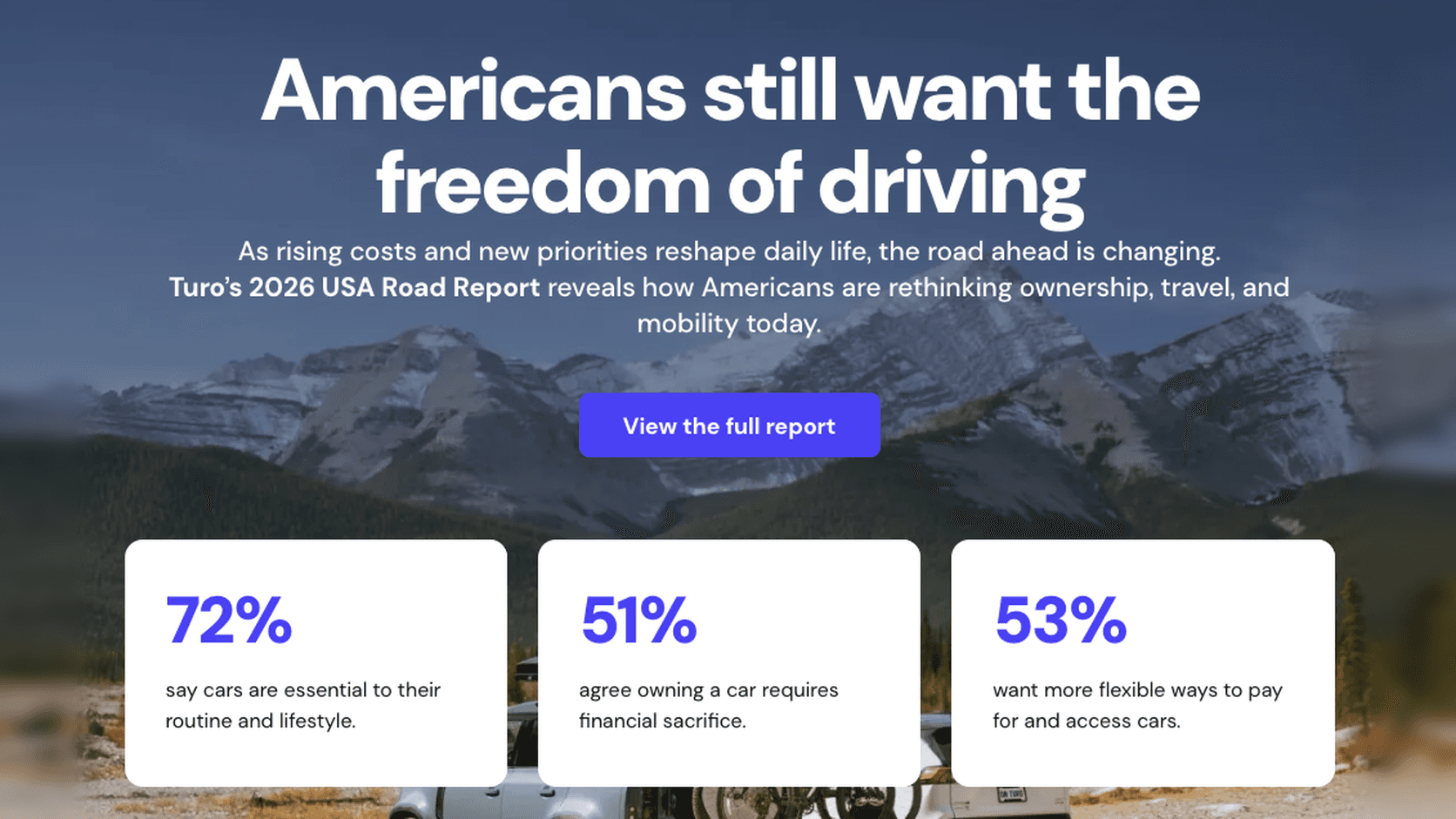
Turo used proprietary consumer research to explore how rising costs, shifting priorities, and emerging technology are reshaping how Americans think about car ownership, travel, and mobility. The report gave Turo a story it could own, with findings designed to fuel PR, content, social, and broader conversations around the future of mobility.
The lesson: Original research can turn a brand’s category expertise into a bigger cultural story, giving marketing teams proprietary insights they can build on across channels.
Joni’s 2026 Period Equity Report
Joni used proprietary research to uncover the gaps between how women experience menopause and the support they receive at work and in everyday life. The findings gave Joni more than a set of statistics. They created a point of view the brand could use to start conversations and build authority around an issue it is uniquely positioned to understand.
The lesson: Research can help a brand move from talking about what it sells to owning a conversation its audience actually cares about.
Pearson’s 2026 Value of IT Certification Employer Report
Pearson used proprietary research to examine how employers view the value of IT certification, from strengthening talent and productivity to preparing workforces for a rapidly changing technology landscape. The research gave Pearson an evidence-based platform for thought leadership with insights that could extend well beyond its products and services.
The lesson: Research gives brands credible evidence to support a point of view, turning marketing claims into stories backed by what real people actually think.
Envoy’s Standard Deviations
Envoy partnered with Cashew to explore how consistency shapes the way consumers experience and perceive brands. The research uncovered the gap between how brands think about consistency and how customers actually experience it, creating a distinctive story that could live across content, events, PR, and social.
The lesson: The strongest research-led stories uncover a tension that gives a brand something new to say, not simply another collection of statistics.
On a smaller scale, Cashew Research publishes its own proprietary data through “Data Drop” reports covering topics like consumer insights on dupe culture, CPG trends, and shifting grocery habits. These demonstrate how proprietary research reports work in practice even without enterprise-scale budgets.
Proprietary Research in Finance
In financial services, the term “proprietary research report” carries a related but distinct meaning. Sell-side research is produced by investment banks and brokerage firms for their clients. Buy-side research is produced internally by asset management firms (hedge funds, mutual funds, pension funds) to guide their own capital allocation decisions.
Buy-side research is proprietary in the truest sense: it stays inside the firm and directly informs trading decisions. The insights are guarded carefully because sharing them would erode the competitive edge they provide.
The European Union’s MiFID II regulations, implemented in 2018, forced a structural change by requiring investment firms to pay separately for external research rather than bundling it with trading commissions. This unbundling made the distinction between proprietary and third-party research even more explicit in financial markets.
If you arrived at this page looking for the finance definition, the core principle is the same: proprietary research is data you own exclusively, whether you are a consumer brand fielding surveys or a hedge fund analyzing market microstructure.
Common Mistakes to Avoid
Treating the Report as the End Goal
Agency practitioners at Zozimus put it bluntly: “The end goal should never be to commission proprietary research. It is a means to an end, and that end is creating a strategy to overcome a business challenge or capitalize on a business opportunity.” The report is an asset. What you do with it determines the ROI.
Failing to Repurpose
A proprietary research report should not live as a single PDF on a landing page. The best-performing teams turn one report into dozens of derivative assets: blog posts highlighting individual findings, social media graphics, pitch decks for sales teams, webinar content, and journalist-ready data stories.
Chasing Broad Topics
“State of Marketing” has been done. “State of Demand Gen” has been done. The reports that generate real attention pick a narrow, specific angle that no one else has covered. Specificity creates the uniqueness that makes proprietary research valuable in the first place.
Skipping Methodology Transparency
If your report does not explain sample size, methodology, and margin of error, sophisticated readers will dismiss it. Transparency is what separates credible proprietary research from a glorified opinion survey.
Ignoring Funnel Position
Practitioners at Campfire Labs note that “most folks at the company will want to trace a direct line from the report to revenue. But research reports are rarely lower-funnel, product-aligned assets, even when they’re based on proprietary product data.” Set expectations correctly. Proprietary research reports are top-of-funnel authority builders that drive awareness, backlinks, and press coverage. They are not product demos.
Getting Started with Proprietary Research
You do not need a six-figure budget or a dedicated research department to produce a proprietary research report. Modern platforms have compressed timelines and costs significantly, making original research accessible to mid-market brands and growing companies. The key is starting with a specific business question, targeting a well-defined audience, and committing to distributing the findings broadly.
See how Cashew’s pricing model works for teams ready to produce their first proprietary research report.
FAQ
What is the difference between proprietary and syndicated research?
Proprietary research is commissioned by one company, which owns the data exclusively. Syndicated research is conducted by a research firm and sold to multiple buyers, meaning competitors can access the same findings. Proprietary research offers a competitive advantage. Syndicated research offers a shared benchmark.
How long does it take to produce a proprietary research report?
From study design to final report, timelines range from a few weeks to several months. The biggest variables are survey design complexity, audience recruitment difficulty, and analysis depth. Modern research platforms like Cashew Research can field surveys in as little as 24 to 72 hours, and process and package the findings in about 1-2 days. Legacy research companies usually take 6-10 weeks from survey design to report.
Can small businesses afford proprietary research?
Yes. The perception that original research requires enterprise budgets is outdated. Self-serve research platforms, CRM-based audience recruitment, and focused study scopes have made proprietary research accessible to growing brands. A narrow, well-designed study targeting a specific audience often produces better results than a massive, expensive survey.
Why is proprietary research important for SEO and AI visibility?
AI systems and search engines prioritize original, citable data. When your proprietary research report becomes the source that other websites reference, you earn backlinks and citations that compound over time. In a content environment flooded with AI-generated articles built on recycled information, original data is the clearest differentiator.
What formats work best for a proprietary research report?
The most common formats include annual benchmark reports, state-of-industry surveys, consumer attitude studies, proprietary indices, and decision-maker interview series. The best format depends on your audience, distribution strategy, and the business question you are trying to answer.
Should proprietary research findings be kept internal or published?
It depends on the goal. Some proprietary research reports stay internal to inform product, pricing, or strategy decisions. Others are published specifically to build brand authority, earn media coverage, and generate backlinks. Many companies do both: keep sensitive competitive findings private while publishing a public version of broader trends and consumer insights.
What is the biggest mistake brands make with proprietary research?
Publishing the report and moving on. The report itself is the raw material, not the finished product. The biggest returns come from repurposing findings into blog posts, social content, sales collateral, pitch decks, and media outreach. One proprietary research report should feed your content calendar for months.